
The Right Way to Jump-Start Your Car – What Most Tutorials Forget to Tell You
When your car refuses to start, the truth is simple: jump-starting is not just about connecting two cables—it is about protecting your car, your battery, and your personal safety. So here is the conclusion right away:
The safest and most effective way to jump-start your car is to control the power flow—slowly, deliberately, and in the right sequence—because rushing the process is what damages batteries and electronics.
Many guides oversimplify the process, making it sound like plugging in a phone charger. But real batteries behave more like water tanks under pressure: if you open the valve too suddenly, the surge can cause damage. Your battery deserves more respect than fast, “just clip it and go” tutorials.
Below is the correct, battery-friendly method.
Why Your Car Won’t Start: the Battery Expert’s Perspective
Before you touch the cables, understand what you’re dealing with:
-
Your battery may be deep-discharged, not fully dead.
-
Cold weather, long parking, or aging can reduce its ability to crank.
-
A jump start does not “fix” the battery—it only gives it a push.
Think of it like helping a friend climb a step: the goal is to assist, not to injure both of you by pulling too hard.
This mindset will help you avoid mistakes that shorten your battery’s lifespan.
How to Jump-Start a Car (Step-by-Step, Battery-Safe Method)
This guide works for both traditional lead-acid and بطاريات AGM.
You will need:
-
A working vehicle أو a jump-starter pack
-
A set of jump leads
-
A safe place to park
1. Position the vehicles or booster safely
Keep the cars close enough for the cables to reach—but do not let them touch. If you use a jump starter, place it on stable ground.
2. Turn everything OFF
This includes lights, AC, and accessories.
Why? Because any active load acts like someone pulling on your arm during a rescue.
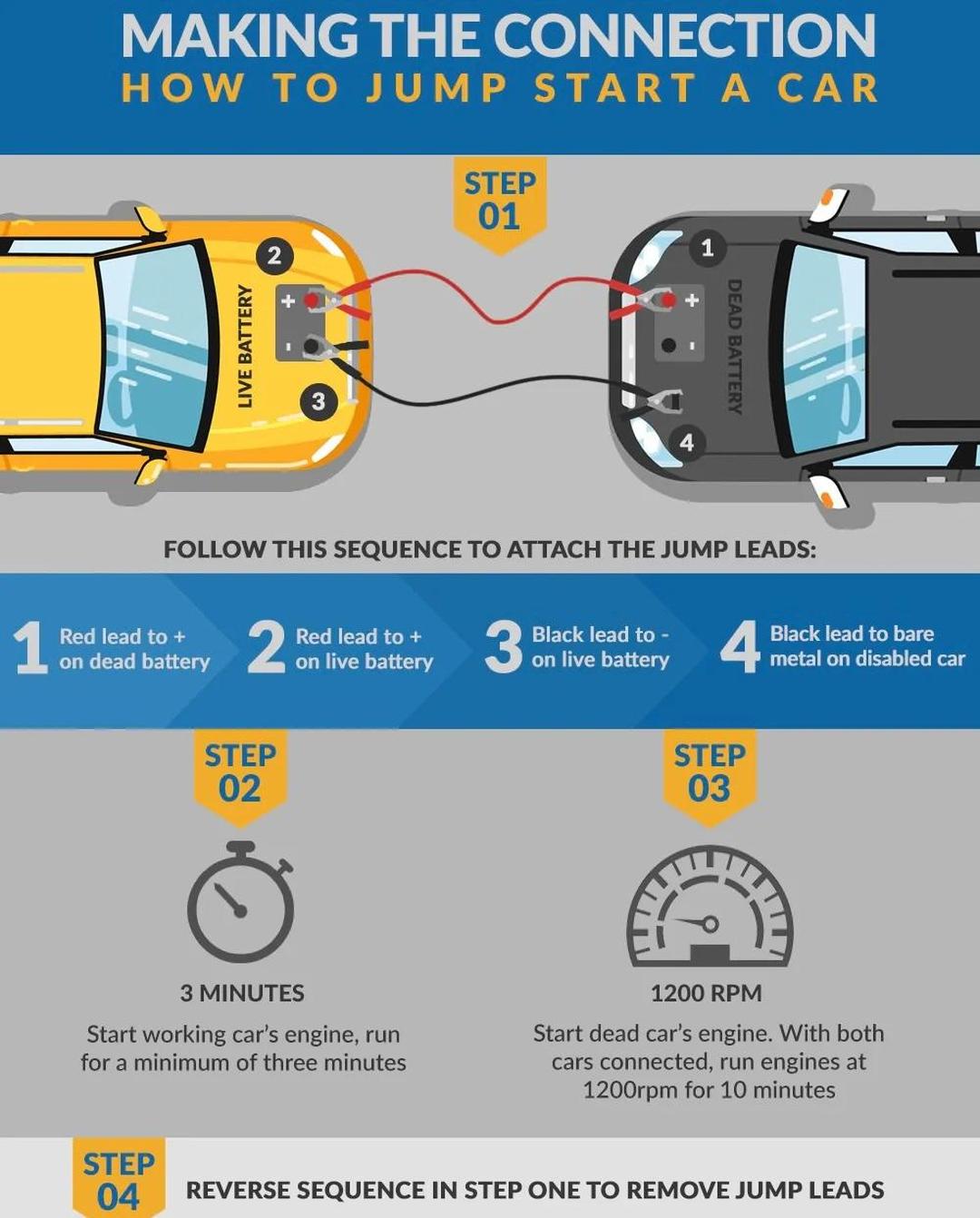
3. Connect the cables in the correct order
Most guides say “red to red, black to black.” That is the surface level version.
Here is the battery-friendly version:
-
Connect red (+) to the dead battery.
-
Connect red (+) to the good battery.
-
Connect black (–) to the good battery.
-
Connect the final black (–) to a bare metal surface on the dead vehicle’s engine block—not the battery.
Why avoid the dead battery’s negative terminal?
Because the last connection often sparks, and you don’t want that spark near explosive gases that gather around a weak battery.
4. Wait 60–120 seconds (the part most guides skip)
Many instructions tell you to start the car immediately.
This is the most common cause of:
-
Cable overheating
-
Battery plate stress
-
Electronic system shock
Give the dead battery a little time to “pre-charge.”
Think of it as letting water flow gently into an empty container before opening the valve fully.
5. Start the assisting vehicle (if applicable)
Let it run 30–60 seconds.
This stabilizes voltage and reduces the load on the donor battery.
6. Start your car
If your car doesn’t start right away:
-
Wait 20 seconds
-
Try again
If it still doesn’t start, stop.
Repeated cranking can damage both cars.
7. Disconnect in the reverse order
-
Remove the black (–) from the metal ground.
-
Remove the black (–) from the good battery.
-
Remove the red (+) from the good battery.
-
Remove the red (+) from your battery.
Work calmly—rushing is how you cause arc sparks.
8. Keep your engine running for 20–30 minutes
You are not “charging” the battery—you are simply giving it enough time to recover.
If the battery is aging or deeply discharged, driving alone may not restore it to full capacity.
Common Mistakes to Avoid (Things Other Guides Don’t Emphasize)
| Mistake | Why It’s a Problem |
|---|---|
| Starting immediately after connecting | Causes current spikes that stress both batteries |
| Connecting the negative clamp to the dead battery | Puts you near hydrogen gas and spark risk |
| Revving the donor engine aggressively | Creates unstable voltage |
| Using cheap, thin jumper cables | They overheat and reduce current flow |
| Jump-starting repeatedly | Indicates a deeper battery or alternator issue |
As a battery supplier and technician, I see most battery failures caused not by age—but by improper jump-starting practices.
A Safer Alternative: a Jump Starter Pack
If you want maximum control and less risk, a modern portable jump starter is often better than another vehicle.
Benefits:
-
Stable voltage
-
No risk to another car
-
Works even when parked in tight spaces
-
Faster and cleaner connection
If you own more than one vehicle or drive in cold climates, it is a worthwhile investment.
Frequently Asked Questions (FAQ)
1. Can jump-starting damage my car?
Yes—if done wrong. Incorrect sequencing and voltage spikes can harm electronics.
2. How long should I let the cables stay connected before starting?
Around 1–2 minutes. This reduces load shock.
3. What if my car still won’t start after jumping?
Your battery may be sulfated or your alternator may be failing.
4. Does idling charge the battery?
Only partially. Driving is more effective.
5. Is jump-starting different for AGM batteries?
The steps are the same, but AGM batteries prefer controlled charging—so avoid revving.



 Arabic
  English
  Russian
  Spanish
  French
  Indonesian